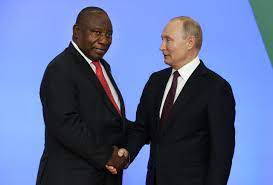

South Africa's Russian love affair
South Africa's navy, mirroring the nation's overall state of
disrepair, faces a significant decline, with its fleet spending less than half
the time at sea compared to a decade ago, largely due to budget cuts by the
ruling African National Congress (ANC). Despite the logical desire for improved
fleets, the hosting of Russian and Chinese navies for joint exercises taking
place on the one-year anniversary of Russia's invasion of Ukraine, these
operations underscore South Africa's shifting alignment, despite claiming to be
“non-aligned” towards the Sino-Russian orbit, a choice that has led to
increasing frustrations from the West.
The ANC has historically harbored a favorable sentiment
towards Russia, often citing Soviet support during the anti-apartheid struggle.
This sentiment, coupled with pragmatic considerations such as South Africa's
membership in the BRICS group, has drawn the country towards the Sino-Russian
sphere of influence. The West had historically been understanding of South
Africa's dual approach, given its pivotal role as a gateway to the continent.
However, the war in Ukraine has brought South Africa's supposed non-alignment
under scrutiny.
South Africa's abstention on condemning Russia's annexation of Ukrainian territory
heightened tensions with the West. Despite charm offensives President Ramaphosa's
decision to abstain indicated the limitations of such efforts in the face of
Russian influence.
The ANC's inclination towards Russia has been further
underscored by high-profile visits, such as that of Russian Foreign Minister
Sergei Lavrov. Statements made during Lavrov's visit, advocating for Russia's
continued presence in Ukraine and suggesting a redesign of the global order
with the BRICS bloc, signaled a deepening alignment with Russian and Chinese
interests.
The naval exercises with Russian and Chinese
participation mark a notable departure, drawing attention to the ANC's growing
links with Russia. Individual ANC politicians' engagements with Russia indicate
personal ties that raise concerns among Western diplomats.
As the ANC government leans towards the Sino-Russian orbit,
the West grapples with how to respond effectively. Some advocate a tougher
stance, questioning preferential trade terms and considering a closer
examination of Russia's links to corrupt South African elites. However, with
the tragedy being that South Africa, in dire need of international support amid
internal challenges, appears to be veering away from its traditional Western
allies, making its global aspirations seem increasingly untenable.